Logical Games
Decide what has to happen first
The Logical tag includes puzzles where the order of your actions matters. A tube of liquid can hold a color you need somewhere else. A square on a grid can become easier to fill once you rule out two possibilities. An arithmetic expression tells you where to begin, even if the first operation you see is on the left. Look for the part of the problem that limits your next choice. Working on that part can be more productive than trying every move that looks possible.
Treat an empty tube as working space
In Color Sort Party, you pour liquids between tubes to group the colors. Before you move a layer, look at what it covers and which tube can receive it. If you pour into the last open space, make sure you know what that choice will let you do next. You might prefer to uncover a color that appears at the top of another tube so there is an immediate place to send it. When a round gets crowded, remember that the tube you clear can be as valuable as the group you complete. It gives you somewhere to put a layer temporarily while you uncover another one.
Mark the possibilities in your head before committing
Meow Sudoku gives a Sudoku-style board a color-based presentation. Look for a part of the grid that already contains several colors. Check the constraints shown in the game, then see which color would be left for an open position. If there is more than one possible answer, leave that square for a moment and examine a crossing part of the board. A choice there might tell you something you could not see from the first square alone. The useful step is often eliminating an option, even before you place anything. Once you have a placement you can explain, check the positions that depended on it.
Read the grouping before doing the arithmetic
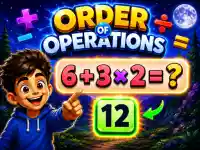
In Order of Operation Challenge, the expression itself gives you instructions about what comes first. Find any brackets before working on the operations around them. Within a group, check for powers or roots and apply the order shown in the game. When multiplication and division share a level, work across them from left to right. Follow the same principle for addition and subtraction once the higher-priority operations are done. Rewrite the expression in your mind after each result so you can still tell the difference between the part you solved and the part that remains. With practice, locating the next operation can become more automatic than the calculation itself.
Try a new board by asking what you can establish with certainty. You may know which color is available on top, which choice cannot fit a square, or which operation has to wait. Use that result to reduce the choices you need to track. If you get stuck, return to the last move you could explain and look at what it made possible. That is a better place to look for a different approach than a position you reached by guessing.